The First Three Weeks of Term Wreck Teacher Sleep - Here Is the Reset
Quick Answer: Term-start exhaustion is mostly a circadian mismatch, not a stamina problem. Six weeks of summer typically shifts bedtime 60 to 90 minutes later, and the alarm does not shift with it. Fix it by moving bedtime 15 minutes earlier every two days for about a week, anchoring 10 minutes of outdoor morning light within half an hour of waking, and keeping weekend wake time within an hour of the school-day one. Wake time is the lever, not bedtime.
Here is the week-by-week reset, and why the usual advice fails teachers specifically.

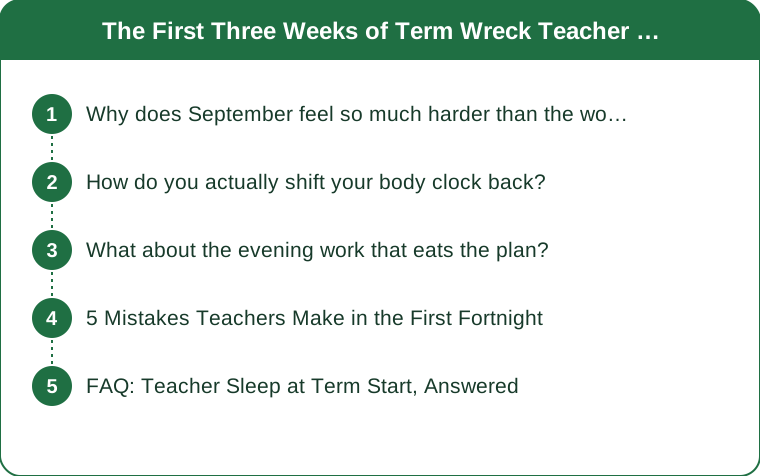
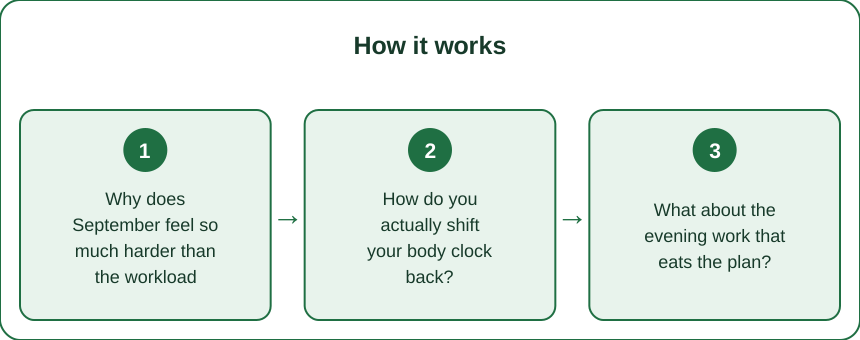
Why does September feel so much harder than the workload alone explains?
Your body clock drifted and the timetable did not. Across six weeks of lighter mornings and later evenings, most people’s natural sleep window slides 60 to 90 minutes later. A 6:15 alarm then lands in what is biologically the middle of your night.
Teaching is unusually poorly suited to sleep debt. It is cognitively demanding, socially demanding, and impossible to do quietly at half capacity. There is no version of a lesson where you coast for twenty minutes.
The first weeks are also front-loaded with novelty - new names, new groups, new routines - which is exactly the kind of work that depends on the sleep-sensitive parts of attention and memory.
Voice fatigue stacks on top of it. Speaking at volume for hours is physically tiring, and poor sleep lowers the threshold at which the voice gets hoarse, which is why the first fortnight so often ends with a rough throat.
And the evenings fill up immediately. Planning and marking take the exact hours you would need to move bedtime earlier, so the debt compounds rather than clearing across the first three weeks.
How do you actually shift your body clock back?
Move in 15 minute steps, every second day. Jumping straight to a 90 minute earlier bedtime means lying awake, which teaches your brain that bed is a place for frustration. Fifteen minutes is small enough that you fall asleep normally.
Start with wake time, not bedtime. Wake time is the anchor your clock actually reads. Set the alarm at the target time from day one and let bedtime follow the sleep pressure it creates.
Get outside within 30 minutes of waking, for at least 10 minutes. Outdoor morning light - even under cloud - is the strongest available signal for advancing the clock, and it is far more powerful than any indoor light. The walk from the car park counts if you make it a long way round.
Dim the house from about 90 minutes before target bedtime. Bright overhead light in the evening delays the clock, which directly undoes the morning walk you did that same day.
Cap the weekend lie-in at one hour past your school wake time. A Saturday and Sunday spent waking three hours later re-creates most of the drift you spent the week correcting - this is the single most common reason the reset never completes.
Front-load caffeine and stop by early afternoon. With a 5 to 6 hour half-life, a 3pm staffroom coffee is meaningfully present at 9pm, exactly when you are trying to fall asleep earlier than usual.
Give it about a week. The clock shifts roughly an hour per week comfortably, so a 90 minute drift takes ten days or so to resolve properly.

What about the evening work that eats the plan?
Put a hard stop on school work 60 minutes before bed and defend it. The work expands to fill whatever time it is given, so the boundary has to be a time rather than a task.
Move marking to the morning where you can. Twenty minutes before school at the desk is usually worth forty at 10pm, and it protects the wind-down window that the reset depends on.
Write tomorrow’s list before you leave the building. The most common cause of teacher insomnia is mentally rehearsing the next day while lying in bed, and an external list on paper reliably reduces it.
Keep the laptop out of the bedroom entirely. Not chiefly for the light - for the association. A bedroom that is also an office is a room your brain treats as a workplace.
Batch the small admin into one block, twice a week. Scattered ten-minute jobs across five evenings occupy far more of the evening than the same work done in two sittings.
Accept that weeks one to three are not representative. The load genuinely is heavier at the start of a term. Judging your whole year by September is a reliable route to feeling defeated in a month that was always going to be hard.
5 Mistakes Teachers Make in the First Fortnight
1. Trying to fix it with one big early night. A single 9pm bedtime after weeks of midnight produces an hour of staring at the ceiling, not a reset. Fifteen minute steps work; heroics do not.
2. Sleeping in heavily on the first weekend. It feels like recovery and functions like a time-zone change. Cap it at one hour past your school wake time and take the rest as an afternoon rest instead.
3. Relying on afternoon caffeine to finish the day. It works for two hours and costs you the earlier bedtime you were aiming for, which makes tomorrow harder than today.
4. Doing the wind-down in bright overhead light. Standing under kitchen spotlights until 10:30 cancels the morning light exposure you made an effort to get.
5. Skipping breakfast and eating at 8pm. Meal timing is a secondary clock signal. An early, protein-containing breakfast reinforces the morning anchor; a late heavy dinner works directly against it.
The pattern in all five is impatience. The clock moves at roughly an hour a week whatever you do, so the goal is consistency rather than intensity - which is genuinely good news in a fortnight with no spare intensity available.
FAQ: Teacher Sleep at Term Start, Answered
How long does it take to reset a sleep schedule?
About a week to ten days for a typical 60 to 90 minute summer drift. The clock advances roughly an hour per week without discomfort, so patience beats intensity.
Should I fix bedtime or wake time first?
Wake time. It is the anchor your body clock reads, and a fixed wake time plus morning light generates the sleep pressure that pulls bedtime earlier on its own.
Does morning light really matter that much?
Yes - it is the strongest practical lever available. Ten minutes outdoors within half an hour of waking, even on a grey morning, beats any indoor lighting by a wide margin.
Can I catch up on sleep at the weekend?
Partly, but a long lie-in re-creates the drift. Keep weekend waking within an hour of your school time and take a short early-afternoon nap instead if you need it.
When should I stop drinking coffee?
Early afternoon. With a 5 to 6 hour half-life, a 3pm cup is still meaningfully present at 9pm, which is precisely when the reset needs you to feel sleepy.
Why does my voice go first?
Sustained speaking at volume is physically demanding, and short sleep lowers the threshold at which the voice tires. The voice tends to recover as sleep does. Persistent hoarseness beyond two weeks deserves proper assessment - this is general information, not medical advice.
What if I still cannot sleep once the schedule is fixed?
If you are getting adequate morning light, keeping consistent times, and still lying awake for weeks, that is worth raising with your GP rather than managing indefinitely on your own.
TL;DR:
- September exhaustion is a circadian mismatch, not weak stamina. Six weeks of summer shifts most people 60 to 90 minutes later.
- Anchor wake time first, then let bedtime follow. Shift in 15 minute steps every second day.
- 10 minutes of outdoor light within 30 minutes of waking is the strongest lever you have.
- Cap the weekend lie-in at one hour past your school wake time, or you undo the week.
- Hard stop on school work 60 minutes before bed, and write tomorrow’s list before you leave the building.
- Caffeine finished by early afternoon - a 3pm coffee is half-present at 9pm.
- Expect about a week to ten days. The clock moves at its own pace regardless of effort.
Weeks one to three are genuinely the heaviest of the year. Do not judge the whole term by them.
Keep Reading
This article is for general informational purposes only and is not medical advice. Always consult a qualified health professional for guidance specific to you.