Why Your Classroom Voice Fails Faster Once the Windows Are Shut
Quick Answer: Central heating drops indoor humidity sharply, and vocal folds need surface moisture to vibrate efficiently. Dry folds require more effort and more airflow for the same volume, which increases friction and inflammation. The fix is systemic hydration, a humidity source in the room, and structural changes to how much you talk - not throat sprays or lozenges.
The voice held up through the first half-term. Then the building’s heating came on, and within a fortnight you were finishing the day with nothing left and starting the next one already rough.
The workload did not change. The air did, and the vocal folds are more sensitive to that than almost any other tissue you use at work.

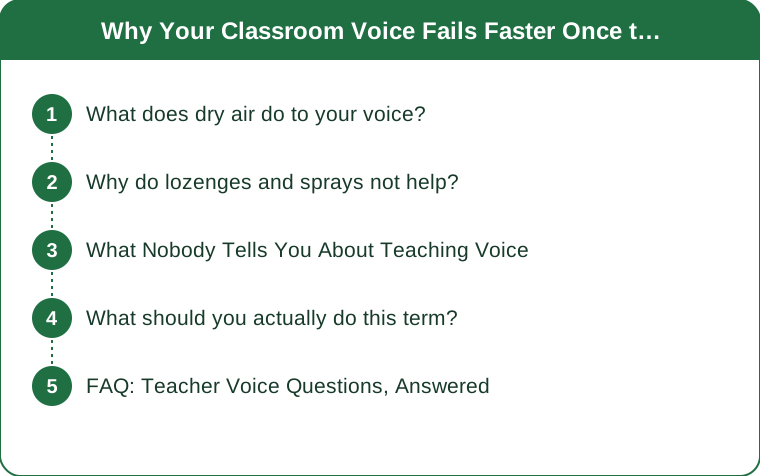
What does dry air do to your voice?
Removes the thin layer of moisture the vocal folds depend on to vibrate cleanly.
The vocal folds vibrate hundreds of times a second during ordinary speech. That vibration is smooth when the surface is properly hydrated, and abrasive when it is not. Surface dehydration increases the pressure required to start and maintain vibration, which means more effort and more airflow for the same volume.
More effort means more collision force between the folds, and more collision means inflammation. Inflamed folds are stiffer, which requires more effort again. That is the loop that turns a manageable first half-term into a difficult second one.
Central heating typically drops indoor relative humidity from a comfortable 40 to 50 percent down into the twenties, sometimes lower in older buildings with radiators running hard. The vocal folds respond to that within hours.
Closed windows compound it in a second way. Classroom air quality falls when a room of thirty people is sealed, and elevated carbon dioxide alongside dust and chalk or whiteboard particulate all irritate the airway. Autumn is when both problems begin at once.
And there is a background noise factor. Closed windows change the acoustics, heating systems add a constant hum, and teachers unconsciously raise their volume to compete with it - typically by several decibels, which is a substantial increase in vocal load across a day.
Why do lozenges and sprays not help?
Because they act on the wrong tissue.
Anything you swallow goes down the oesophagus. The vocal folds sit in the airway, which is a different tube, and nothing you drink touches them directly. Hydration reaches the folds systemically, through the bloodstream, which takes time and requires consistent fluid intake rather than a drink when you notice a problem.
Lozenges and sprays soothe the pharynx, which is genuinely where some of the discomfort is felt, and they do not rehydrate the folds. Worse, menthol and eucalyptus preparations are mildly drying, and anaesthetic lozenges mask the pain that would otherwise tell you to stop - which is how a strained voice becomes an injured one.
Steam is the exception, because inhaled water vapour does reach the airway directly. A few minutes of steam inhalation after a heavy teaching day is one of the few interventions that acts on the right tissue.
So the effective approach is unglamorous: drink consistently through the day rather than in bursts, put moisture into the air of the room, breathe steam when the voice is tired, and reduce the load. Caffeine and alcohol are mildly dehydrating and worth moderating in a bad week, though their effect is smaller than the volume of talking you do.
This is general information rather than medical advice. Hoarseness lasting more than two weeks, pain on speaking, or any change in your voice that does not resolve with rest should be assessed by a doctor, and teachers are a group where referral to a voice specialist is entirely routine.

What Nobody Tells You About Teaching Voice
The voice fails in October, not September, and that is diagnostic. If your voice reliably goes at the same point every year, it is the heating rather than the term. That pattern tells you the intervention is environmental.
Amplification is not an admission of weakness. Personal voice amplifiers - a small speaker and a lapel mic - are used routinely by teachers with voice problems, cost surprisingly little, and cut vocal load dramatically. Many schools will fund one if asked, and they are standard equipment in some districts.
Whispering is worse than speaking. It is the single most common piece of well-meant advice given to a hoarse teacher and it is wrong. Whispering holds the folds in a tense position with high airflow and is more damaging than quiet normal speech. If you must protect the voice, speak quietly rather than whisper.
Silence between lessons is worth more than anything else. The folds recover during rest, and the staffroom at break is where a great deal of vocal load happens. Two genuinely quiet breaks a day make a bigger difference than any product.
And classroom management technique is vocal health technique. Non-verbal attention signals, waiting rather than talking over noise, positioning yourself close to the class rather than projecting from the front, and using a bell or a visual cue all reduce vocal load substantially. The teachers who never lose their voice are usually the ones who talk least, not the ones with the strongest voices.
What should you actually do this term?
Change the air, change the load, and hydrate properly.
Get moisture into the room. A small humidifier is ideal where allowed. Failing that, a bowl of water on the radiator, plants, and opening windows briefly between lessons all help, and the ventilation break also clears the carbon dioxide.
Drink consistently rather than in bursts. A bottle on the desk, sipped through the day, keeps you systemically hydrated in a way a large drink at lunch does not. Room temperature water is easier to drink steadily than cold.
Reduce the amount you talk. This is the highest-return change and the hardest one. More student talk, more written instruction, more non-verbal signalling, and never talking over a noisy room. Wait instead, every time.
Ask for an amplifier. Frame it as a preventive occupational health request, because that is what it is.
Build in vocal rest. Two quiet breaks a day, minimal talking on the commute, and a genuinely quiet evening after a heavy teaching day.
Warm the voice up in the morning. Gentle humming, lip trills, and easy glides for two or three minutes before the first lesson. Singers do this as standard and teachers use their voices for far longer in a day than most singers do.
And use steam when the voice is tired rather than lozenges. A bowl of hot water and a towel, or a hot shower, five minutes.
If the voice does not recover over a weekend, that is a signal to seek advice rather than push through a half-term.
FAQ: Teacher Voice Questions, Answered
Is it normal to lose my voice every autumn?
Common, and not something to accept as inevitable. A recurring seasonal pattern usually points at a manageable cause - dry air, increased volume against background noise, and the accumulated load of a full timetable - all of which respond to the changes above.
Does the type of drink matter?
Water is the main thing and consistency matters more than the specific drink. Very hot drinks and heavily caffeinated ones are mildly irritating or drying in quantity, and honey in warm water is soothing to the throat even though it does not reach the folds.
When should I see a doctor?
Hoarseness persisting beyond two weeks, pain when speaking, a voice that does not recover with rest, or any lump or swallowing difficulty. Teachers are at genuinely elevated occupational risk of voice disorders, and early assessment by a voice specialist has good outcomes.
TL;DR:
- Central heating drops humidity sharply, and dry vocal folds need more effort and more airflow to vibrate, which causes inflammation.
- Lozenges and sprays act on the throat, not the folds - only systemic hydration and inhaled steam reach the right tissue.
- Whispering is worse than quiet speech, and the staffroom at break is where a lot of vocal load hides.
- Humidify the room, sip water all day, reduce how much you talk, ask for an amplifier, and warm the voice up in the morning.
If your voice goes at the same point every October, that is a clue rather than a coincidence. The heating came on, and nobody warned you it was an occupational hazard.
Keep Reading
This article is for general informational purposes only and is not medical advice. Always consult a qualified health professional for guidance specific to you.