Why Standing All Day Tires You More Than Walking All Day
Quick Answer: Walking uses your calf muscles as a pump that pushes blood back up toward the heart. Standing still switches that pump off while gravity keeps working, so blood pools in the lower legs, the same postural muscles hold a fixed contraction for hours, and fatigue builds without any of the recovery that movement provides. The fix is not more endurance - it is breaking the stillness. Weight shifts, a rail or box to rest one foot on, two minutes of walking every half hour, and shoes chosen for standing rather than for walking.
You hiked all weekend and felt great.
Then you stood through third period and your legs filed a complaint that lasted until Thursday.

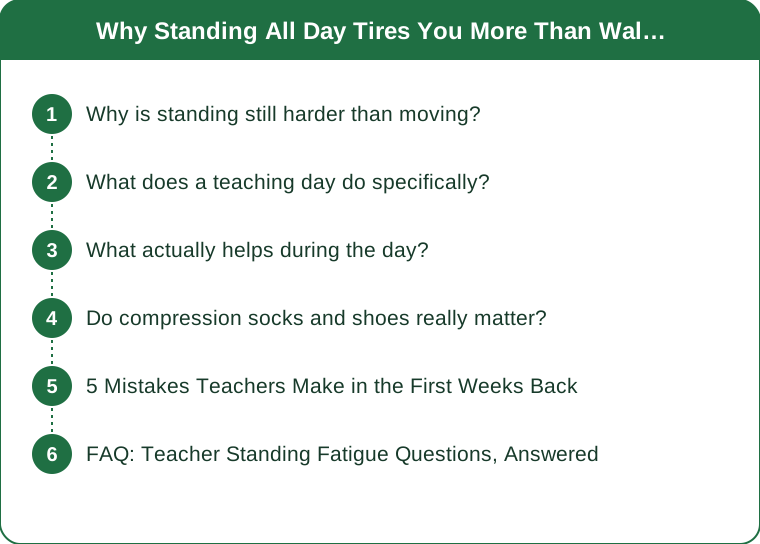
Why is standing still harder than moving?
Your calves are a second heart. Every step compresses the deep veins and pushes blood upward against gravity, which is why walking circulates blood while standing does not.
Standing still shuts that pump off while gravity keeps pulling fluid downward, so blood and fluid pool in the lower legs across the day.
Static contraction is more fatiguing than dynamic contraction. Holding one position means the same muscle fibres stay engaged continuously, with no alternating rest, and they run out of resources faster.
Walking rotates the work. Different fibres take turns, blood flows through the working tissue, and metabolic waste clears as you go.
Pooling also explains the swelling. Shoes feeling tighter at 3pm than at 8am is fluid, not weight gain, and it is a direct measure of how still your day was.
Which is why the fittest person in the building can still be wrecked by a day of standing in one spot.
What does a teaching day do specifically?
The standing is not continuous but it is close, and the short seated intervals during a planning period are rarely long enough to matter physiologically.
Hard floors multiply everything. Tile and concrete under thin flooring reflect impact and give no compression relief, and classrooms are almost always one of those.
You stand in a small radius rather than covering ground, which feels like movement and is not - two thousand steps spread across six hours is close to standing still as far as the calf pump is concerned.
You cannot sit down when your body asks, which is the specific difference from most standing jobs where a brief lean is possible.
Talking loudly while standing raises the overall load, because breath support engages the trunk continuously alongside everything else.
And the first weeks back are the worst, because summer removed the adaptation you spent the previous year building.
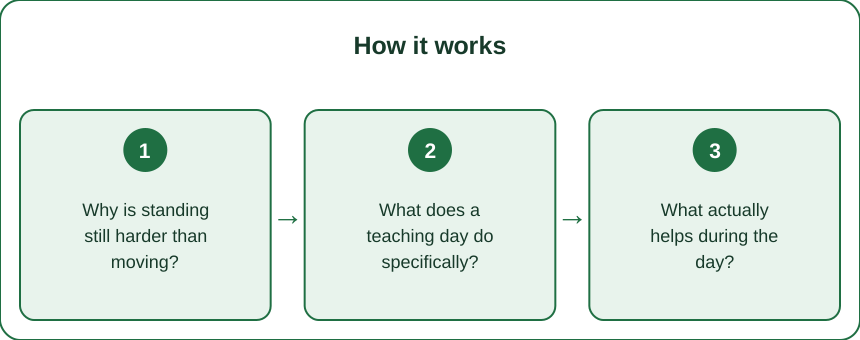
What actually helps during the day?
Shift your weight deliberately, roughly every few minutes. It sounds trivial and it is the single most effective intervention, because it restarts the pump before pooling sets in.
Put one foot up on something low. A footrest, a low shelf, the base of a desk - a few inches of elevation on one leg, alternating sides, relieves the lower back and interrupts the static hold.
Walk two minutes every half hour if the lesson allows it. Circulating between desks during independent work is genuinely restorative, not just classroom management.
Do ten calf raises between classes. Rising onto the toes and lowering pumps the deep veins directly and takes twenty seconds.
Sit fully when you get the chance, with the feet flat. Perching on a stool with the legs dangling keeps the pressure on.
And keep drinking water. Dehydration thickens blood and makes pooling worse, and teachers under-drink because bathroom access is scheduled.

Do compression socks and shoes really matter?
Graduated compression socks are the highest-value item on this list for anyone standing all day, because they mechanically assist the return that your still calves are not providing.
15-20 mmHg is the usual starting range for healthy legs with occupational standing, and it is available in ordinary-looking socks now.
Standing shoes and walking shoes are different problems. Walking shoes are built for heel-to-toe transition; standing needs cushioning under the whole foot and a stable, wide base.
Rotate two pairs across the week rather than wearing one daily, since foam needs about a day to decompress and a day-old sole gives measurably less.
A cushioned mat at the spot where you stand most - the front board, the lab bench - is a small purchase that changes a lot on a tile floor.
And replace shoes on hours, not appearance. Standing shoes flatten out long before they look worn, usually around eight to twelve months of daily teaching.
5 Mistakes Teachers Make in the First Weeks Back
1. Treating leg fatigue as a fitness problem. It is a circulation problem. Adding evening cardio to a body that stood still for six hours often makes the next day worse, not better. Movement during the day beats movement after it.
2. Wearing the summer shoes into September. Sandals and flat canvas shoes were fine for a schedule that never involved six hours upright on tile. The switch back to a teaching day needs a shoe with actual cushioning and support.
3. Skipping water because of bathroom timing. Understandable and counterproductive. Dehydration worsens pooling, headaches and voice strain simultaneously, and the fix is front-loading fluids in the morning rather than drinking less overall.
4. Standing in the same square metre all lesson. The front-of-room anchor is a habit rather than a requirement. Moving through the room every ten minutes serves the teaching and the legs at once.
5. Collapsing on the sofa immediately after school. Going from six hours of standing to three hours of sitting with the legs down keeps the fluid where it is. Ten minutes with the legs up a wall drains it, and it is the thing people skip because it feels like doing nothing.
And the bonus everyone underestimates: the adaptation is real and it comes back. Weeks one to three are genuinely the hardest, and the same day in October costs noticeably less.
FAQ: Teacher Standing Fatigue Questions, Answered
How long does it take to adapt after summer?
Most people notice a clear difference by the third or fourth week back, with the biggest jump between weeks two and three. The first week is not a preview of the year.
Are compression socks safe to wear every day?
Graduated compression in the 15-20 mmHg range is designed for daily occupational wear. If you have a circulatory or vascular condition, check with a clinician first about the right level.
Is a standing desk in the classroom a good idea?
Only alongside a stool. The benefit comes from alternating, and a standing desk that removes the last opportunity to sit makes the day harder.
Why do my feet hurt more than my legs?
Hard flooring with under-cushioned shoes concentrates load in the arch and heel. Persistent morning heel pain on the first steps out of bed is worth having assessed rather than absorbing.
Does swelling in the ankles matter?
Mild swelling that resolves overnight is common with occupational standing. Swelling in one leg only, or swelling with pain, warmth or redness, should be looked at promptly.
What helps most in the evening?
Ten to fifteen minutes with the legs elevated above heart level, then a short easy walk. The order matters - drain first, then move.
This is general information, not medical advice.
TL;DR:
- Walking runs the calf pump that returns blood upward; standing still switches it off while gravity keeps working.
- Static muscle contraction fatigues far faster than alternating dynamic work.
- Weight shifts, one foot elevated, and ten calf raises between classes interrupt the pooling.
- Graduated compression socks (15-20 mmHg) and standing-specific rotated shoes do the most.
- Legs up the wall for ten minutes after school beats collapsing on the sofa.
It is not that you got out of shape over the summer - you stopped being still for a living.
Keep Reading
This article is for general informational purposes only and is not medical advice. Always consult a qualified health professional for guidance specific to you.