Movement Breaks That Actually Fit Into a Real Teaching Schedule
Quick Answer: A realistic teacher movement routine fits inside passing periods and duty-free lunch — think 90-second standing stretches between classes and one 5-minute walk during lunch, not a full workout squeezed into a planning period that doesn’t exist most days.
Generic ‘take movement breaks throughout your day’ advice assumes a level of schedule control most teachers simply don’t have. Here’s a version built around an actual bell schedule.

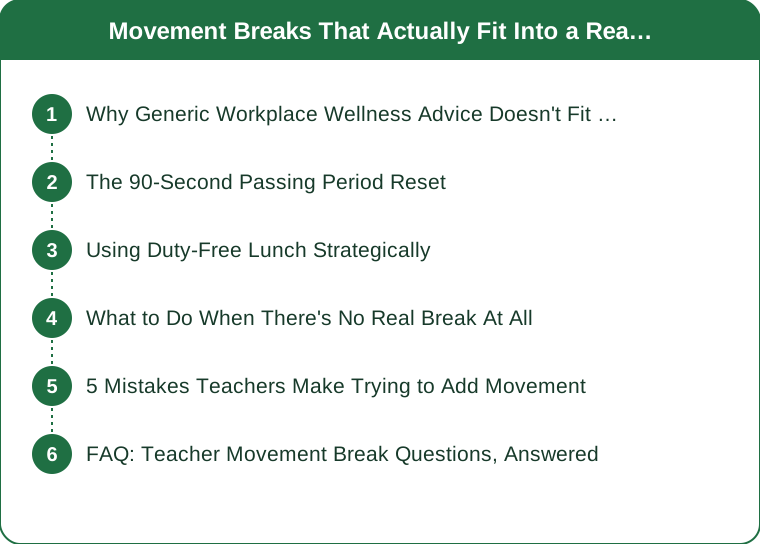
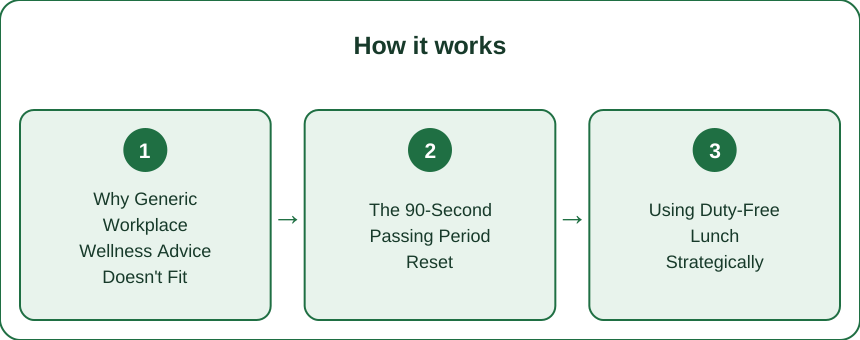
Why Generic Workplace Wellness Advice Doesn’t Fit Teaching
Most workplace movement advice assumes flexible breaks you can take whenever you choose. A teaching schedule is broken into fixed, non-negotiable blocks — passing periods of 3-5 minutes, a duty-free lunch that may or may not actually happen, and instructional time where leaving isn’t an option. Movement advice needs to be built around those exact constraints, not generic office norms.
The 90-Second Passing Period Reset
Between classes, while students transition, do a quick sequence: shoulder rolls, a standing back extension, and a few calf raises while monitoring the hallway. This isn’t a workout — it’s a circulation reset that combats the specific stiffness of standing and lecturing for 50 minutes straight.
Using Duty-Free Lunch Strategically
If your duty-free lunch is a genuine 20-30 minutes, splitting it into 15 minutes eating and a brisk 5-10 minute walk (even just laps around the building or a hallway loop) provides real cardiovascular benefit without cutting meaningfully into eating or grading time.

What to Do When There’s No Real Break At All
On days with no functional break (common with lunch duty or back-to-back coverage), build movement into instruction itself: teach a segment standing and walking rather than seated, or build in a stretch break for students that you participate in too. This isn’t a compromise — it models healthy movement habits for students while covering your own needs.
5 Mistakes Teachers Make Trying to Add Movement
1. Planning an elaborate routine that requires 10+ uninterrupted minutes, which rarely materializes. 2. Feeling guilty about brief movement in front of students, when short teacher stretches are unremarkable and often go unnoticed. 3. Skipping movement entirely on hard days instead of doing a scaled-down 30-second version. 4. Not using the classroom itself — walking while monitoring group work counts as real movement. 5. Waiting for a ‘good day’ with more time instead of building a version that works even on the worst schedule day.
FAQ: Teacher Movement Break Questions, Answered
Is 90 seconds actually enough to matter?
Repeated short movement breaks throughout a day have been shown to meaningfully reduce stiffness and improve circulation compared to one long sedentary stretch, even if each break is brief.
What if my school doesn’t guarantee duty-free lunch?
Even a genuinely uninterrupted 5 minutes of standing and walking while supervising is better than none — look for the smallest reliable window rather than waiting for an ideal one.
Can movement breaks help with end-of-day exhaustion?
Many teachers report less end-of-day fatigue with regular short movement breaks, likely because standing and circulation resets counter the specific fatigue of prolonged static standing and speaking.
TL;DR:
- Build movement around real bell-schedule constraints, not generic office advice
- Use 90-second passing periods for quick standing resets
- Split duty-free lunch into eating time plus a brisk short walk
- On no-break days, teach standing or add a shared stretch break with students
The goal isn’t fitting a workout into teaching — it’s finding the small, realistic windows that already exist in the school day and using them consistently.
Keep Reading
This article is for general informational purposes only and is not medical advice. Always consult a qualified health professional for guidance specific to you.