Why Grading Papers Might Be Straining Your Neck More Than Standing All Day
Quick Answer: Grading involves sustained, downward-angled neck flexion for extended periods, which creates more cumulative strain on neck muscles than many teachers realize — raising the paper stack to closer to eye level with a simple document holder or angled surface, and taking short posture breaks every 20-30 minutes, meaningfully reduces this strain.
Grading time doesn’t get the same ergonomic attention as classroom standing or desk setup, but the sustained head-down posture it requires is a real, measurable source of neck strain for many teachers.

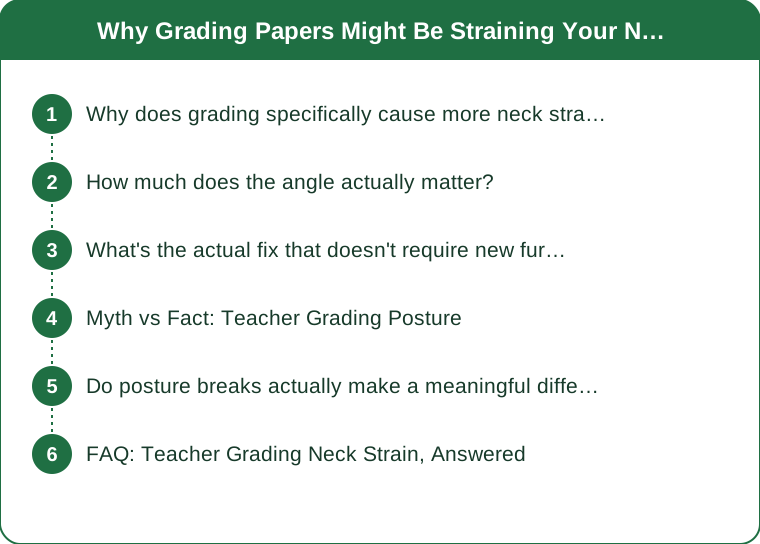
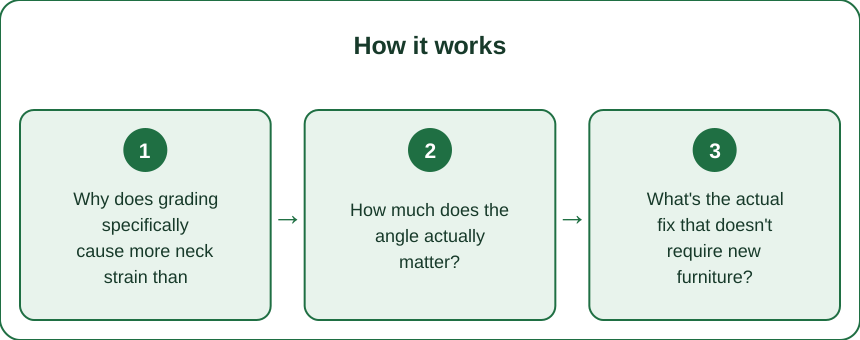
Why does grading specifically cause more neck strain than expected?
Looking down at a stack of papers on a flat desk surface requires sustained neck flexion — the head tilted forward and down — often for long, uninterrupted stretches during evening or planning-period grading sessions. This sustained angle places continuous load on neck and upper back muscles in a way that’s different from the more varied movement of standing and walking through a classroom during teaching hours.
How much does the angle actually matter?
Even a modest downward head tilt significantly increases the effective load on neck muscles compared to a more neutral, eye-level position — this is well-documented in general desk ergonomics research, and grading sessions, often done at a flat table or kitchen counter, tend to involve a steeper angle than most people realize until they consciously check it.
What’s the actual fix that doesn’t require new furniture?
A simple document holder or angled clipboard that raises the paper closer to eye level reduces the neck flexion angle substantially, without needing any new furniture. Propping papers against a stack of books or a laptop stand at an angle works as a free, immediate version of the same fix if a dedicated document holder isn’t available.

Myth vs Fact: Teacher Grading Posture
Myth: “Neck strain from grading is just an unavoidable part of the job.” Fact: much of it comes from a fixable flat-angle setup, not an unavoidable task requirement — the grading itself doesn’t require the strain, the typical setup does.
Myth: “Standing to grade instead of sitting solves the problem.” Fact: standing doesn’t change the neck angle if the papers are still on a low, flat surface — angle matters more than standing versus sitting for this specific issue.
Myth: “Short grading sessions don’t need posture breaks.” Fact: even a 20-30 minute session in a poor angle contributes to cumulative strain that adds up across a week of regular grading, not just during marathon sessions.
Do posture breaks actually make a meaningful difference during a grading session?
Yes — briefly lifting the head to a neutral position and gently rolling the shoulders every 20-30 minutes interrupts the sustained-flexion pattern that causes most of the cumulative strain. This doesn’t need to significantly slow down grading pace — a few seconds of repositioning between papers or sections is enough to meaningfully break up the sustained load.
FAQ: Teacher Grading Neck Strain, Answered
Does grading on a tablet or laptop instead of paper reduce this strain?
It can, if the screen is propped at a better angle than a flat desk surface — but a laptop screen positioned too low creates the same problem, so screen height matters as much as switching to digital.
Is it worth investing in a proper document holder, or is a DIY solution enough?
A DIY solution (books, an angled binder) works reasonably well — a dedicated document holder is a modest, inexpensive upgrade worth it mainly for convenience and consistency, not because DIY options don’t work.
How do I know if grading posture is actually the cause of my neck pain versus something else?
Neck tension that’s noticeably worse on heavy grading days or after long grading sessions specifically points to this as a contributing factor — this is general information, not medical advice, and persistent pain is worth having evaluated.
TL;DR:
- Sustained downward neck angle during grading creates real cumulative strain, distinct from classroom standing fatigue
- A document holder or simply propping papers up reduces the neck flexion angle without new furniture
- Standing to grade doesn’t fix the issue if the papers are still positioned too low
- Brief posture breaks every 20-30 minutes interrupt the sustained-strain pattern effectively
Neck strain from grading isn’t an unavoidable cost of the job — it’s largely a fixable setup problem most teachers have simply never had pointed out to them.
Keep Reading
This article is for general informational purposes only and is not medical advice. Always consult a qualified health professional for guidance specific to you.