Why Hallway Duty Wrecks Your Legs More Than a Full Day of Teaching
Quick Answer: Static standing during hallway or lunch duty causes more leg and lower back fatigue than a full day of classroom teaching because standing still restricts blood flow return from the legs in a way that walking and position changes don’t — teaching involves frequent small movements that act as a natural pump, while duty periods often require staying in one spot for 20-30 minutes at a stretch.
Teachers often assume duty periods should feel easier than active teaching time, since there’s less talking and less physical activity involved — but the opposite is often physiologically true.

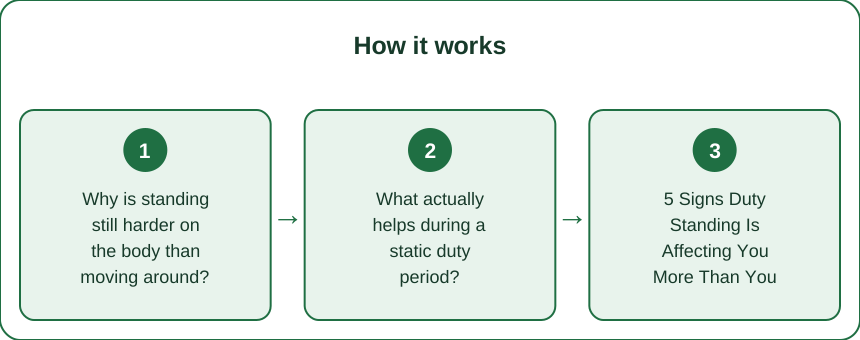
Why is standing still harder on the body than moving around?
Because leg muscle contractions during walking and position shifts help pump blood back up toward the heart — a mechanism called the muscle pump. Standing static for extended periods reduces this pumping action, allowing blood and fluid to pool in the lower legs, which is what produces that heavy, achy feeling by the end of a duty period.
What actually helps during a static duty period?
Small, subtle movements — shifting weight foot to foot, gentle calf raises, or a slow walking patrol path instead of a fixed spot — reactivate the muscle pump without abandoning the supervision role duty requires. Even non-obvious movement (weight shifting every 30-60 seconds) meaningfully reduces the pooling effect compared to fully static standing.

5 Signs Duty Standing Is Affecting You More Than You Realize
1. Ankles look visibly more swollen after duty days than after full teaching days.
2. Lower back tightness that wasn’t present during the teaching day itself.
3. Needing to sit immediately after duty ends, more than after a full class period.
4. Leg heaviness that doesn’t match how little walking actually happened.
5. Compression socks or supportive shoes making a noticeably bigger difference on duty days specifically.
Does footwear matter differently for duty versus classroom teaching?
Yes — a shoe built for standing stability (firm heel counter, supportive arch) matters more for static duty periods than for a classroom day with more natural movement variety, where a slightly less structured shoe might still feel fine. Considering duty and classroom days as different physical demands, not the same ‘teaching day’ category, helps match footwear more specifically.
FAQ: Teacher Duty Fatigue Questions, Answered
Do compression socks actually help with duty-specific standing fatigue?
Yes — graduated compression socks specifically assist the muscle pump mechanism that static standing reduces, making them more useful for duty periods than for a moving classroom day.
Is it worth requesting a rotating rather than fixed duty spot?
Worth considering if the school’s duty structure allows it — a rotating patrol path naturally reintroduces the walking-based muscle pump that a fixed spot doesn’t.
Does this fatigue pattern get worse later in the school year?
Often yes, cumulatively — repeated static standing without addressing it can compound into more persistent lower leg and back discomfort over a semester, making early small changes (footwear, movement pattern) worth addressing rather than waiting it out.
TL;DR:
- Static standing during duty restricts the leg muscle pump more than active teaching does
- Small movements — weight shifting, a patrol path — meaningfully reduce pooling and fatigue
- Duty-specific footwear (firm heel counter, arch support) matters more than general teaching shoes
- Compression socks target this specific static-standing mechanism directly
Treat duty periods as their own physical demand, separate from classroom teaching — the fatigue mechanism is genuinely different.
Keep Reading
This article is for general informational purposes only and is not medical advice. Always consult a qualified health professional for guidance specific to you.