The Skin Care Routine Teachers on Recess Duty Actually Need
Quick Answer: Daily outdoor duty (recess, yard supervision, outdoor PE coverage) adds up to meaningfully more cumulative UV exposure over a school year than most teachers account for in a single morning skincare routine — reapplying sunscreen specifically before outdoor duty blocks, not just in the morning, is the single most impactful fix.
You put on sunscreen with your morning routine, then spend 20-30 minutes outside on duty most days without thinking about it again. Over a school year, that gap adds up to real, cumulative sun exposure most teachers never planned for.

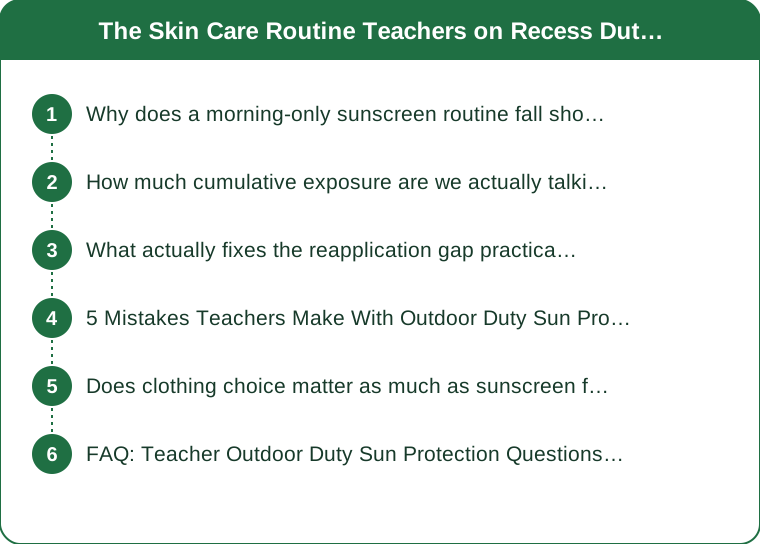
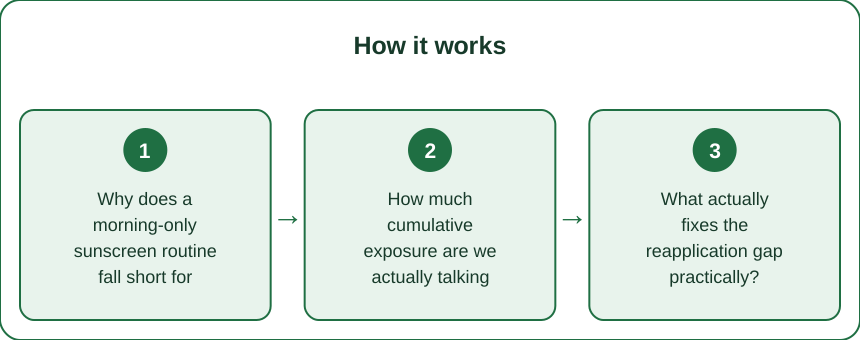
Why does a morning-only sunscreen routine fall short for teachers specifically?
Most sunscreens are effective for roughly two hours before their protection meaningfully degrades, especially with any sweating or friction from clothing and movement in between. A teacher who applies sunscreen at 7am and then does a 20-30 minute outdoor duty block at 10am or noon is often working with significantly diminished protection by the time they’re actually outside, even though it feels like the morning routine “covered” the day.
This is compounded by recess and yard duty often falling during peak UV hours (late morning through early afternoon), which is exactly when unprotected or under-protected exposure does the most damage.
How much cumulative exposure are we actually talking about over a school year?
A conservative estimate of 20-30 minutes of outdoor duty most school days across a 180-day school year adds up to roughly 60-90 hours of outdoor exposure annually, concentrated in exactly the midday window when UV intensity peaks. That’s a meaningful amount of sun exposure that’s easy to mentally file as “just standing around” rather than recognizing as a real, cumulative skin health variable worth actively managing.
What actually fixes the reapplication gap practically?
Keeping a travel-size sunscreen in a desk drawer or bag specifically for duty days, applied right before heading outside rather than relying on the morning application, closes the timing gap directly. A broad-spectrum SPF 30+ stick or spray formula applies quickly over makeup without much disruption, which matters for a realistic between-classes or before-duty routine that can’t involve a full skincare re-do.

5 Mistakes Teachers Make With Outdoor Duty Sun Protection
Assuming morning sunscreen lasts the whole school day. Protection meaningfully fades within a couple hours.
Not accounting for reflected UV from pavement or playground surfaces. Reflected exposure adds to direct sun exposure, particularly on concrete or asphalt yard areas.
Wearing a hat but skipping sunscreen on the face and neck anyway. A hat helps but doesn’t fully replace sunscreen, especially for areas like the lower face and neck that hat brims don’t always cover.
Forgetting lips, which burn and dry out from repeated sun exposure too. An SPF lip balm is a small, often-skipped addition.
Not reapplying after any midday hand-washing or face-touching that removes product. Routine hygiene habits can inadvertently remove sunscreen before duty time.
Does clothing choice matter as much as sunscreen for outdoor duty?
It contributes meaningfully — UPF-rated clothing or simply choosing tighter-woven, darker fabrics for duty days provides a layer of protection that doesn’t degrade the way topical sunscreen does over a few hours. Combined with a wide-brim hat covering the face, neck, and ears (rather than just a baseball cap), clothing choices reduce how much the sunscreen reapplication gap actually matters.
FAQ: Teacher Outdoor Duty Sun Protection Questions, Answered
Is SPF in daily makeup or moisturizer enough for outdoor duty?
Generally not on its own — most SPF-containing makeup provides lower, less reliable protection than a dedicated sunscreen application, and doesn’t solve the reapplication timing gap either.
Does cloud cover during recess duty mean sun protection matters less?
No — up to 80% of UV rays pass through cloud cover, so overcast duty days still carry meaningful exposure risk even though it doesn’t feel as intense as direct sun.
Is it worth requesting shaded duty positions if available at a school?
Where schools have shaded or partially shaded supervision zones, rotating into them when possible measurably reduces exposure, though supervision needs often require covering unshaded areas too, making topical and clothing protection the more consistently reliable fix.
TL;DR:
- A morning-only sunscreen routine loses meaningful effectiveness before midday duty blocks even start
- 20-30 minutes of daily duty over a school year adds up to significant cumulative UV exposure
- Keeping travel sunscreen for duty-specific reapplication closes the most common gap
- UPF clothing and a proper wide-brim hat reduce how much the reapplication gap actually matters
Recess duty looks like standing around, but from a UV standpoint it’s real, repeated sun exposure — a five-second reapplication habit before heading out closes a gap most morning routines never accounted for.
Keep Reading
This article is for general informational purposes only and is not medical advice. Always consult a qualified health professional for guidance specific to you.