How Substitute Teachers Can Survive a Full Day Without Losing Their Voice by 10am
Quick Answer: Substitute teachers lose their voice faster than regular classroom teachers because they’re projecting into an unfamiliar room, over unfamiliar noise levels, without established routines to reduce how much talking is required. A visual attention signal, established in the first five minutes, cuts vocal strain more than any single technique.
A regular classroom teacher has routines built up over months that reduce how much they need to raise their voice. A substitute walks into a room with none of that, and by 10am on a full sub day, the strain shows.

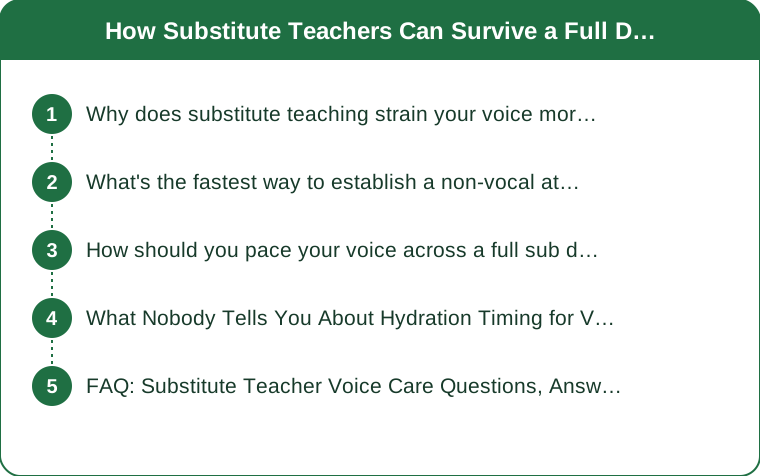
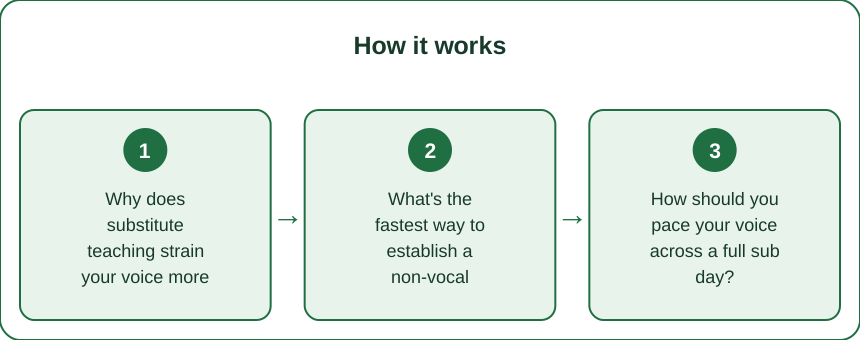
Why does substitute teaching strain your voice more than regular teaching?
Because established classroom routines — a specific clap pattern for attention, a known call-and-response, a settled sense of what’s expected — significantly reduce how often a regular teacher needs to project loudly for control. A substitute has none of that built-in cooperation and often has to rely on volume alone to manage a room, especially early in the day before any rapport is established.
This compounds across multiple classes or periods in a single day, since each new room resets the process from zero.
What’s the fastest way to establish a non-vocal attention signal?
In the first five minutes of any class, introduce one simple, consistent visual or physical signal for attention — a raised hand that students are asked to mirror, a specific phrase paired with a hand clap pattern, or simply writing ‘when I raise my hand, please stop talking’ on the board and explaining it once, clearly, before the class gets loud.
Even with an unfamiliar class, most students respond reasonably well to a clearly explained signal introduced calmly at the start, and it meaningfully reduces how much vocal projection you need for the rest of that period specifically.

How should you pace your voice across a full sub day?
Treat vocal energy like a finite resource across the day, not an infinite one — save your loudest projection specifically for genuine safety or attention-reset moments, and rely on the visual signal plus a lower, calm, but clearly enunciated voice for regular instruction and redirection.
Between classes or during any break, actual silence — not just quieter talking — gives your voice a real chance to recover; even five minutes of not speaking during a passing period adds up meaningfully across a full day.
What Nobody Tells You About Hydration Timing for Voice Care
Sipping water steadily throughout the day matters less than most people assume — what actually helps more is avoiding caffeine and very cold water specifically before periods of heavy talking, since both can have a mildly drying or constricting effect on vocal cords for some people. Room-temperature water, sipped consistently, tends to support voice endurance better than occasional gulps of ice water between classes.
A small, often-overlooked habit: humming softly or gently warming up your voice for 30 seconds before a first class of the day, similar to how a physical warm-up precedes exercise, can reduce strain on the first, coldest use of your voice.
FAQ: Substitute Teacher Voice Care Questions, Answered
Should I use a voice amplifier for substitute teaching?
A portable voice amplifier is a genuinely effective tool for reducing vocal strain across a full sub day, particularly in larger rooms or with classes prone to more noise, and it’s worth considering if substitute teaching is a regular, ongoing role rather than an occasional one.
How do I recover my voice if it’s already strained by midday?
Genuine vocal rest — minimizing talking during any breaks, avoiding whispering (which can strain vocal cords more than normal speaking) — is more effective than any specific remedy; warm, non-caffeinated tea can also feel soothing though the evidence for direct vocal cord benefit is limited.
Is losing your voice occasionally from substitute teaching something to be concerned about?
Occasional mild strain that resolves with rest is common and not usually concerning, but voice loss that persists for several days, happens very frequently, or comes with pain is worth discussing with a doctor, since it could indicate a more significant vocal strain issue.
TL;DR:
- Substitute teaching strains voices faster due to a lack of established classroom routines
- Establish a visual attention signal in the first five minutes of each class
- Pace vocal energy across the day — save loud projection for genuine attention resets
- Room-temperature water and a brief vocal warm-up help more than most people expect
A five-minute investment in a visual signal at the start of class pays off in vocal strain saved for the rest of the day.
Keep Reading
This article is for general informational purposes only and is not medical advice. Always consult a qualified health professional for guidance specific to you.