Why Your Voice Gives Out by 2pm (And What Actually Helps Teachers)
Quick Answer: Teacher voice fatigue comes from projecting over classroom noise for hours without vocal rest breaks — hydration, using a portable voice amplifier for large or loud classes, and building in brief silent moments (independent work time) meaningfully reduce the strain.
By 2pm your voice is scratchy, quieter, and you’re reaching for a fourth cup of water that doesn’t seem to help. This is an occupational hazard most teacher training never actually addresses.

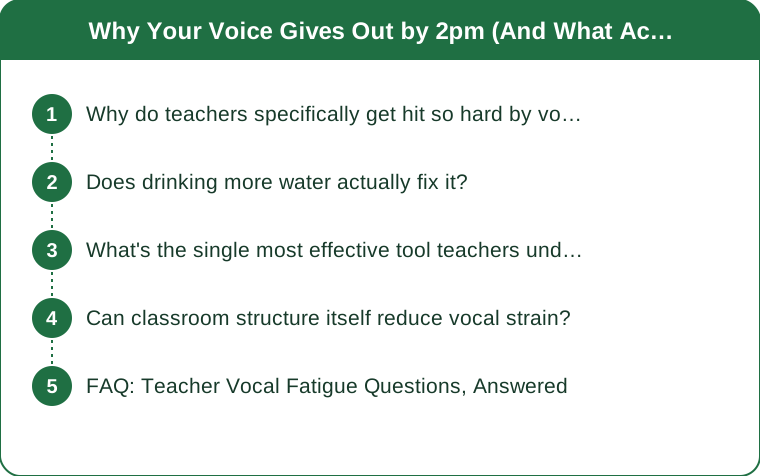
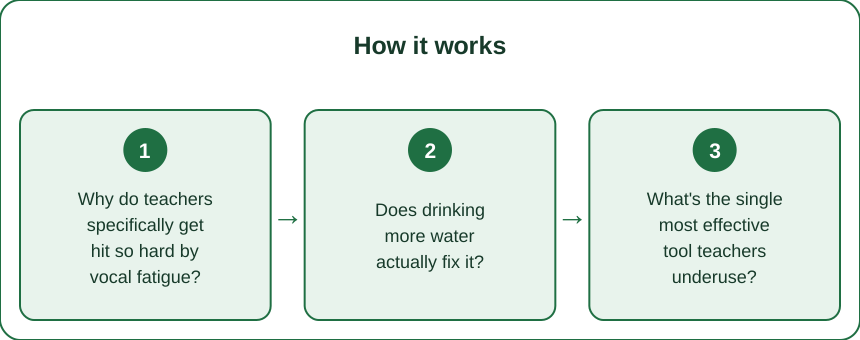
Why do teachers specifically get hit so hard by vocal fatigue?
Teaching requires sustained projection over ambient classroom noise for hours, often at a pitch and volume above your natural speaking register — this repeated strain on the vocal folds is a recognized occupational risk, comparable to what singers or call-center workers experience.
Does drinking more water actually fix it?
Hydration helps keep vocal folds lubricated, but it’s not a complete fix on its own — the mechanical strain of loud, sustained talking needs actual volume reduction strategies too, not just more water.

What’s the single most effective tool teachers underuse?
A portable voice amplifier (small clip-on speaker, often under $50) lets you speak at a normal conversational volume while still being heard across a loud room — this single change removes most of the daily strain that builds toward the 2pm crash.
Can classroom structure itself reduce vocal strain?
Yes — building in short independent or partner work blocks gives your voice genuine rest periods throughout the day rather than six hours of continuous projection, which is often the bigger lever than any vocal technique.
FAQ: Teacher Vocal Fatigue Questions, Answered
Are throat lozenges or tea actually helpful?
Warm (not hot) tea with honey can soothe irritation, but they’re a comfort measure, not a fix for the underlying volume strain.
When should vocal fatigue be seen by a doctor?
If hoarseness persists for more than 2-3 weeks, or you lose your voice regularly, an ENT evaluation is worth it — chronic vocal strain can lead to nodules if untreated.
Does classroom acoustics matter?
Significantly — rooms with hard surfaces and no sound absorption force much louder projection than a room with carpet, curtains, or acoustic panels, so simple classroom changes can reduce strain too.
TL;DR:
- Sustained projection over classroom noise is a real occupational vocal hazard
- Hydration helps but doesn’t solve the mechanical strain alone
- A portable voice amplifier is the single biggest relief most teachers skip
- Built-in quiet work blocks give your voice real recovery time Your 2pm voice isn’t weakness — it’s an unaddressed occupational strain with genuinely simple fixes.
Keep Reading
This article is for general informational purposes only and is not medical advice. Always consult a qualified health professional for guidance specific to you.