Why You Get Sick the First Week of Every Break — and How to Not
Quick Answer: Getting sick as soon as a break starts is common enough to have a research name — the let-down effect. During sustained stress, cortisol and adrenaline suppress certain inflammatory and immune responses; when the stressor lifts, that suppression releases and symptoms that were being masked surface at once. Teachers are unusually exposed because the stress is both prolonged and sharply terminated, and because the last two weeks before a break are typically the highest-load period of the term. Tapering rather than crashing is the practical prevention.
Every break, the same script. Friday you finish. Saturday you feel a bit off. Sunday you’re flat on your back with a sore throat, watching the first two days of a hard-earned week disappear.

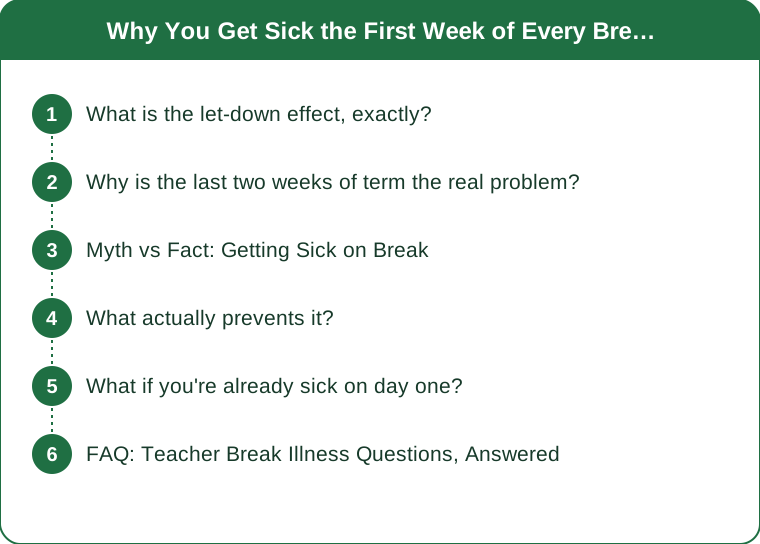
What is the let-down effect, exactly?
A documented pattern where illness and symptom flares cluster in the period immediately after a stressor ends rather than during it.
The mechanism, in outline: sustained psychological stress elevates cortisol and catecholamines. Cortisol has anti-inflammatory effects, which is why short-term stress can temporarily suppress symptoms — you genuinely do feel less of a cold during a crisis. When the stressor lifts, those hormones fall, the suppression releases, and inflammatory responses rebound. Symptoms that were held down become obvious.
There’s a second layer. Prolonged stress also appears to impair some aspects of immune function over time, which can make you more genuinely susceptible to the infections you were exposed to during the term — and a classroom is a very high-exposure environment. So it isn’t only symptoms surfacing; sometimes it’s an infection that took hold during the last stressful weeks and is now expressing.
Migraine research shows the pattern most clearly. Studies of migraine sufferers have found elevated attack risk in the 12 to 24 hours after a decline in perceived stress — the let-down period — rather than during peak stress itself.
Why teaching is a near-perfect setup for it:
- The stress is chronic across a term, not episodic
- It ends abruptly rather than tapering
- The final two weeks are usually the highest-load stretch: assessments, reports, events, and covering for sick colleagues
- Sleep debt accumulates and is only repaid after the stressor ends
- Classroom exposure to circulating viruses is constant
This is general information, not medical advice.
Why is the last two weeks of term the real problem?
Because that’s where the load and the exposure both peak, and where the buffers are already spent.
Workload compresses. Grading deadlines, reports, end-of-term events, and the administrative tail all land in the same fortnight. The hours go up exactly when the reserves are lowest.
Sleep gets cut first. It’s the most available currency and the most expensive one. Even modest sleep restriction is associated with reduced immune response, and by week fourteen of a term the debt isn’t small.
Cover duties increase. Colleagues get sick, and the ones still standing absorb their classes. More contact hours, less recovery, more viral exposure.
Meals and hydration slide. Eating at your desk in eight minutes, coffee instead of water, and skipping lunch entirely during report season are all near-universal.
Movement stops. Whatever exercise routine survived October usually doesn’t survive the last two weeks.
And then it stops dead. Friday afternoon, the entire load lifts at once. That sharp discontinuity is the trigger condition.
The key insight: the intervention window is the two weeks before the break, not the break itself. By the time you’re on the sofa on Saturday, the outcome was mostly set the previous fortnight.
Myth vs Fact: Getting Sick on Break
Myth: You’re getting sick because you finally relaxed and let your guard down. Fact: Relaxation doesn’t cause infection. What changes is hormonal suppression of symptoms lifting, plus a possible immune rebound. The virus was already there or the inflammation was already building.
Myth: It’s psychosomatic — you’re not really ill. Fact: The symptoms are real and often the infection is too. The let-down effect describes timing, not imagination.
Myth: Powering through the last two weeks is the responsible choice. Fact: It’s the choice that most reliably costs you the first three days of your break. Protecting sleep in the final fortnight buys back more usable time than the extra evening hours produce.
Myth: Vitamin C at the start of break will prevent it. Fact: Evidence for vitamin C preventing colds in the general population is weak; it may modestly shorten duration in some groups. Sleep, on the other hand, has consistent evidence behind it.
Myth: If you exercise hard on day one of break, you’ll shake it off. Fact: Intense exercise in a depleted, possibly-incubating state is more likely to extend the illness than shorten it. Gentle movement, yes. A two-hour session to “reset,” no.
Myth: It happens to everyone, so nothing can be done. Fact: It’s common but not inevitable. The people who avoid it are usually the ones whose final two weeks aren’t dramatically different from their normal weeks — and that’s partly a schedulable choice.

What actually prevents it?
A taper, not a crash. The strategy is to reduce the height of the cliff.
In the final two weeks:
- Protect sleep first. Set a hard lights-out time and treat it as non-negotiable for the last fortnight. If grading has to give, grading gives. Seven hours is the target most adults need; the difference between 6 and 7.5 hours in this window is disproportionate.
- Front-load the admin. Reports and grading spread across four weeks instead of two is the same total work with half the peak. This is the highest-leverage change and it’s a calendar decision made in week one, not week thirteen.
- Keep one anchor habit. Whatever your baseline movement is, keep a reduced version rather than dropping it. A 15-minute walk daily beats a suspended gym routine.
- Eat lunch. Away from the desk, with protein. This sounds trivial and it is the thing most reliably abandoned.
- Hydrate deliberately. A bottle on the desk with a target of finishing it twice. Voice use and classroom air both increase the requirement.
In the first three days of break:
- Don’t schedule anything demanding. Treat day one and two as buffer by design rather than discovering they were buffer by illness.
- Sleep in, but not drastically. A shift of more than about two hours creates its own grogginess and disrupts the rhythm you’ll need back.
- Move gently. Walk, stretch, easy swim. Not a heroic session.
- Keep meal timing roughly consistent for the first few days rather than eating at random hours.
The reframe that helps most: plan the first two days of every break as recovery days on purpose. If you don’t get sick, you get two calm days. If you do, you lost nothing you’d allocated.
What if you’re already sick on day one?
Damage control, and it’s mostly about not extending it.
Rest genuinely, early. The strong instinct is to push through because the break is short and precious. Two full rest days at the start commonly costs less total time than five days of half-functioning.
Hydrate and prioritize sleep over everything. Sleep is where immune work happens, and it’s the one variable you now fully control.
Don’t exercise into it. Light walking is fine. Anything that leaves you breathless is likely to prolong things, particularly with any chest involvement or fever.
Manage symptoms so you can sleep. Whatever your usual approach — steam, honey and warm liquids for throat, saline rinse for congestion — the goal is uninterrupted sleep rather than being functional during the day.
Protect your voice specifically. Teachers start the next term with a voice that has to work immediately. Talking through a sore throat with laryngitis is how a one-week problem becomes a term-long one. Genuine voice rest during a throat infection is a professional investment, not indulgence.
When it’s not a normal break-cold: fever above 102°F, shortness of breath, symptoms worsening after initially improving, severe throat pain making swallowing difficult, or anything lasting beyond ten days without improvement warrants a healthcare professional. Recurrent illness at every single break is also worth mentioning to a doctor — the pattern is common, but persistent fatigue has other causes worth ruling out.
This is general information, not medical advice. See a healthcare professional for symptoms that are severe, worsening, or persistent.
FAQ: Teacher Break Illness Questions, Answered
Why do I feel fine during the hardest weeks and terrible when it stops?
Stress hormones suppress inflammatory symptoms while they’re elevated. When they fall, that suppression releases and everything that was being masked arrives at once. It’s a timing effect, not a sign the stress was harmless.
Does this happen to people in other jobs?
Yes — it’s documented across high-stress occupations and in students after exams. Teaching is a particularly clean example because the stress ends on a specific date rather than tapering, and because classroom viral exposure is unusually high.
Is there any evidence that supplements help?
Nothing with strong evidence for preventing this specific pattern. Vitamin D deficiency is worth checking with your doctor, particularly in winter, and correcting a genuine deficiency has clearer support than general supplementation. Sleep and workload distribution have far better returns than anything on a shelf.
TL;DR:
- The let-down effect is real: stress hormones suppress symptoms, and lifting the stress releases that suppression.
- The decisive window is the final two weeks of term, not the break itself.
- Protect sleep, spread the admin load across more weeks, keep one movement habit, and actually eat lunch.
- Plan the first two days of every break as recovery by design, so you lose nothing if it happens anyway.
You can’t schedule around a virus. You can absolutely schedule around a workload cliff.
Keep Reading
This article is for general informational purposes only and is not medical advice. Always consult a qualified health professional for guidance specific to you.