Why Your Energy Crashes in Week Three of Every Term and Not Week One
Quick Answer: The week-three crash is accumulated debt becoming visible. Sleep debt builds silently across two weeks, adrenaline from a new term masks fatigue for roughly 10-14 days, and physical loads — standing, projecting your voice, no proper breaks — accumulate faster than you recover from them. Front-load sleep and recovery in weeks one and two, when you do not yet feel like you need them.
Week one: fine.
Week two: tired but coping.
Week three: flattened. Every year, and it is a scheduling problem, not a resilience problem.

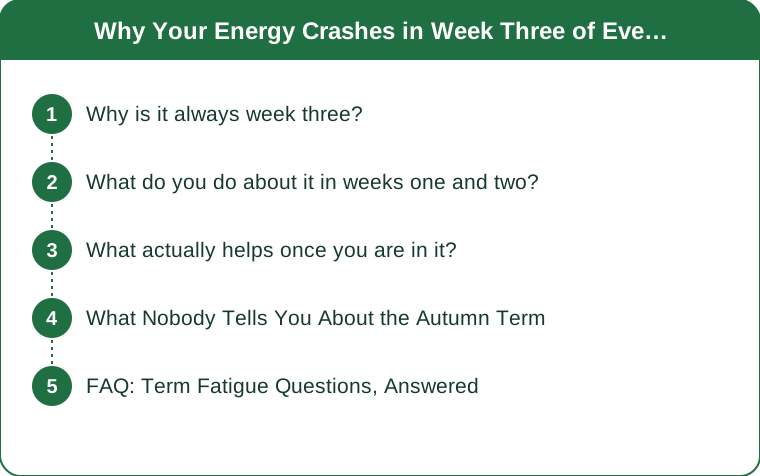
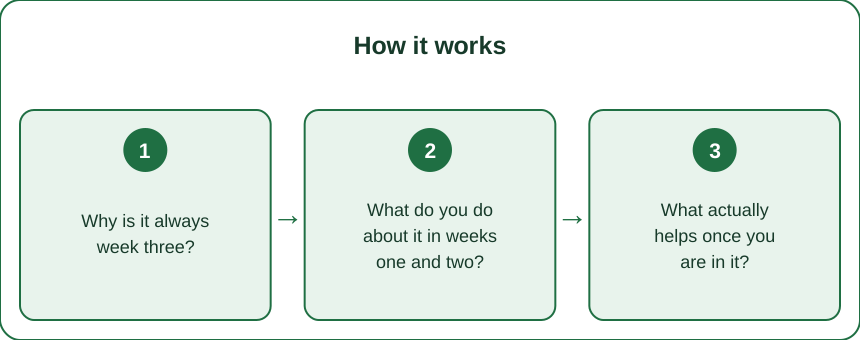
Why is it always week three?
Six things that compound on almost exactly the same timeline.
Sleep debt accumulates invisibly. Losing an hour a night is barely noticeable on day one. By day fourteen it is a substantial deficit, and cognitive and mood effects of accumulated sleep loss are well documented — with the added problem that your self-assessment of impairment gets less accurate as the debt grows.
Adrenaline masks fatigue for about two weeks. A new term, new classes and a new routine produce genuine arousal that suppresses tiredness. When novelty fades, the underlying state becomes visible all at once, which is why the crash feels sudden rather than gradual.
Physical load accumulates too. Teachers stand for most of the day, often on hard floors. Two weeks of that with inadequate recovery produces genuine musculoskeletal fatigue.
Vocal load is the underestimated one. Talking loudly for hours daily is athletic use of the voice. Vocal fatigue accumulates across days and typically becomes noticeable in the second or third week, which is exactly when the throat problems start.
Immune exposure peaks. Returning to a building full of people after a break means a wave of circulating infections, and incubation puts the illness at — reliably — week two to three.
And your holiday sleep pattern has to shift. Most people drift 1-2 hours later over a break. Snapping back to a term wake time creates a circadian mismatch that takes one to two weeks to resolve, which is another thing landing in the same window.
What do you do about it in weeks one and two?
Six actions, all of which feel unnecessary at the time.
Shift your sleep schedule before term starts, not after. Move your bedtime 15-20 minutes earlier per day for the week before term. It is the single most effective intervention and the one almost nobody does.
Protect sleep hardest in weeks one and two. The instinct is to use the early-term energy to get ahead on planning. Spending it on sleep instead is what prevents the crash. Whatever you gain in week one, you lose with interest in week three.
Prepare weeks three and four in advance. Do the planning that requires real cognitive effort while you still have it. Your week-three self needs materials, not ambitions.
Manage your voice deliberately from day one. Hydrate constantly, use non-verbal attention signals, and avoid raising your voice over noise — wait for quiet instead. Vocal rest at lunch matters more than it sounds. Voice problems are among the most common occupational health issues in teaching.
Take actual breaks. A break spent at your desk answering email is not recovery. Ten minutes outside, standing up and not talking, does substantially more for both the physical and vocal load.
Move your hardest personal commitments out of week three. If you know the crash is coming — and you do — do not schedule anything demanding into it. This is planning, not weakness.
Seasonal note: autumn term is the hardest of the year for this, because the crash coincides with falling daylight. Losing roughly two minutes of daylight a day through September means the week-three crash lands as morning light is disappearing, which affects both waking and mood. Getting outside for 10-15 minutes in the morning is a genuinely effective countermeasure and takes a break you should be taking anyway.

What actually helps once you are in it?
Six recovery levers, ranked.
Sleep is the only thing that repays sleep debt. Not caffeine, not a weekend lie-in alone. Consistent earlier bedtimes across several nights. A single long weekend sleep helps but does not clear a two-week deficit.
Front-load caffeine and stop by early afternoon. Caffeine has a half-life of around 5-6 hours, so a 4pm coffee is still meaningfully present at 10pm. Late caffeine to survive the crash directly extends the sleep debt causing it.
Eat lunch properly, away from your desk. Blood glucose stability matters for afternoon function, and a skipped or grazed lunch is a common feature of crash weeks.
Reduce optional load for one week deliberately. Not everything is essential in week three. Choosing what to drop is better than having it chosen for you when you get ill.
Ten minutes of daylight and movement. Both improve alertness measurably and both are achievable within a school day. Morning light is best for resetting the sleep-wake cycle.
Wear something that does not add to the load. Standing for hours in unsupportive shoes is a real physical cost, and clothing that pinches when you crouch to a child’s desk or rides up when you reach the top of a board is a constant small distraction. Comfortable, well-fitting workwear is a working condition, not a vanity concern. This is general information, not medical advice — persistent exhaustion, voice loss or low mood beyond a couple of weeks deserves a conversation with a professional.
What Nobody Tells You About the Autumn Term
Nobody tells you the crash is predictable. It happens at roughly the same point every year, to most teachers, for the same physiological reasons. Knowing the date changes what you can do about it.
Nobody tells you to spend week one on sleep. The culture rewards using early-term energy on preparation. The people who prepare in the holidays and sleep in week one are consistently in better shape by October.
Nobody tells you your voice is an occupational load. Teachers have among the highest rates of voice disorders of any profession, and almost none receive vocal training. Ten minutes of vocal rest at lunch is a genuine intervention.
Nobody tells you that the illness in week three is not bad luck. A building full of people after a break, plus depressed immune function from accumulated sleep debt, plus incubation time, lands exactly there.
Nobody tells you that autumn term compounds with the light. Spring and summer terms have the same structure without daylight falling away underneath them. This is why autumn feels harder than the timetable suggests.
Nobody tells you that planning for the crash is professional. Scheduling lighter demands into a week you know will be hard is exactly what you would advise a colleague to do, and it is the thing teachers most reliably fail to do for themselves.
FAQ: Term Fatigue Questions, Answered
Why week three specifically?
Sleep debt accumulates for two weeks, novelty-driven adrenaline masks fatigue for about the same period, and circulating infections have had time to incubate. They arrive together.
How do I prevent it?
Shift your sleep 15-20 minutes earlier per day in the week before term, and protect sleep hardest in weeks one and two, when you feel like you do not need it.
Does a weekend lie-in fix sleep debt?
It helps and does not clear a two-week deficit. Several consistent earlier bedtimes do more than one long sleep.
When should I stop drinking coffee?
Early afternoon. Caffeine’s half-life is 5-6 hours, so a 4pm coffee still affects sleep at 10pm.
How do I protect my voice?
Hydrate constantly, use non-verbal attention signals, never talk over noise, and take vocal rest at lunch. Voice problems are a leading occupational issue in teaching.
Why is autumn term worse than the others?
The crash coincides with rapidly falling daylight — roughly two minutes a day through September.
When should I get help?
If exhaustion, voice loss or low mood persists beyond a couple of weeks despite recovery efforts, speak to a professional.
TL;DR:
- Week three is when two weeks of sleep debt, fading novelty adrenaline and incubated infections all surface together.
- Shift bedtime earlier before term starts, 15-20 minutes a day.
- Spend weeks one and two on sleep, not on getting ahead — prepare in the holidays instead.
- Protect your voice from day one: hydrate, use non-verbal signals, rest it at lunch.
- Stop caffeine by early afternoon, and get 10-15 minutes of morning daylight.
Look at your calendar and find week three of this term. Move anything optional out of it now, while it still costs you nothing.
Keep Reading
This article is for general informational purposes only and is not medical advice. Always consult a qualified health professional for guidance specific to you.