Why Your Voice Gives Out on Thursdays and Not Mondays
Quick Answer: Vocal fold tissue needs roughly 12 to 16 hours of low-use recovery after heavy loading, and a normal teaching week does not provide it. Small daily deficits accumulate, which is why Thursday feels worst. Recovery is most effective in the first two hours after your last class, not on the weekend.
Monday, your voice is fine. Tuesday, mostly fine. By Thursday afternoon you are pushing to be heard over group work, and your throat feels like you swallowed something.
Then the weekend fixes it, and Monday resets. Every week, the same curve.
That curve is a debt schedule.

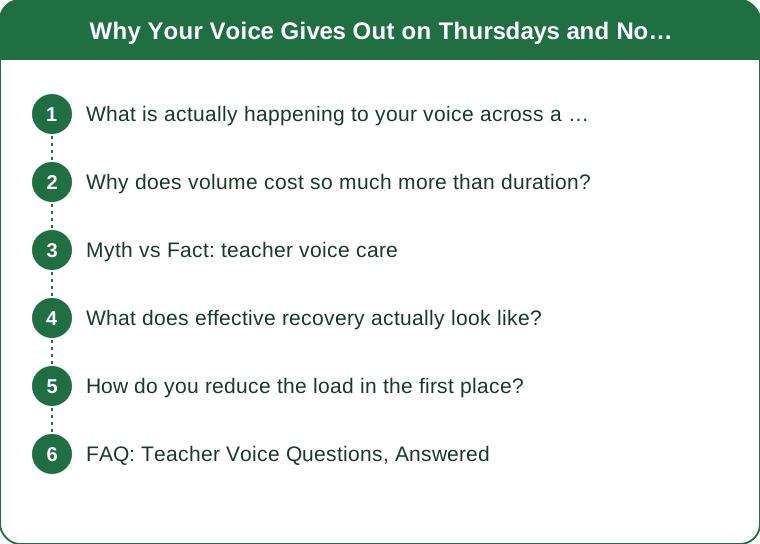
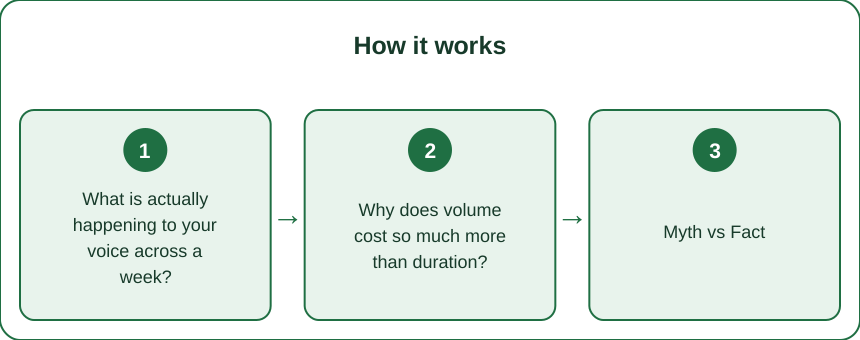
What is actually happening to your voice across a week?
Your vocal folds vibrate at roughly 200 times per second in typical female speech and around 120 in male speech. A teacher speaking for four hours of a school day accumulates an enormous number of vibratory cycles.
That vibration causes mechanical stress and a small amount of tissue swelling — normal, and normally reversible. Research on vocal loading indicates tissue needs on the order of 12 to 16 hours of substantially reduced use to return to baseline.
A teaching day ends at 3 or 4pm and the next begins at 8am. That is 16 hours on paper, but only if the intervening time is genuinely quiet — and it usually is not. Coaching, phone calls, family dinner, a loud restaurant, a workout class.
So each day you recover perhaps 80 percent of the deficit. Carry that four days forward and the shortfall is obvious by Thursday. The weekend, with two full days of light use, clears it — which is why Monday feels fine and the pattern repeats indefinitely.
Why does volume cost so much more than duration?
Because vocal effort does not scale linearly with loudness.
Raising vocal intensity requires higher subglottal pressure and increases the force of vocal fold collision on each cycle. Speaking at a raised level rather than a conversational one meaningfully increases the impact stress per vibration — and you are doing hundreds of vibrations per second.
This is why twenty minutes over a noisy group activity can cost more than an hour of quiet instruction. Teachers often track their fatigue against total speaking time and find it does not explain the pattern. Volume-weighted time does.
Background noise is the driver. The Lombard effect means you involuntarily raise your voice as ambient noise rises, typically without noticing. A classroom at 65 dB during group work pulls your voice up automatically, and you are not making a conscious choice you could simply decide against.
Myth vs Fact: teacher voice care
Myth: Clearing your throat helps when it feels rough. Fact: Throat clearing slams the vocal folds together forcefully and increases irritation, which produces more mucus, which prompts more clearing. Swallow, or sip water instead.
Myth: Whispering rests your voice. Fact: Forced whispering can be as strenuous as normal speech, because it holds the folds in a tense configuration with turbulent airflow. If you need to rest, use silence, not whispering.
Myth: Honey and tea repair the vocal folds. Fact: Nothing you drink touches your vocal folds — they are below the epiglottis, in the airway. Warm drinks feel soothing to the pharynx and encourage hydration, which genuinely helps, but the mechanism is systemic hydration, not coating.
Myth: Voice problems are just part of teaching. Fact: Teachers do have elevated rates of voice disorders — it is one of the most vocally demanding professions. But it is a known occupational risk with known mitigations, not an inevitability.

What does effective recovery actually look like?
The timing matters more than the total. The first two hours after your last class are the highest-leverage window.
Build a hard silence block. Twenty minutes of complete voice rest immediately after the school day — not talking, not whispering, not singing along in the car. This single habit does more than anything on the weekend.
Hydrate systemically and early. Vocal fold tissue hydration depends on overall body water, and it lags intake by hours. Drinking a liter at 4pm does not help the 10am class. Aim for steady intake through the day — a 500 ml bottle finished by mid-morning and again by lunch.
Use humidified air. Classroom humidity in heating or cooling season commonly sits below 30 percent. A small desk humidifier or a personal steam inhaler for 5 minutes in the evening genuinely helps.
Do semi-occluded exercises. Straw phonation — humming through a straw into a glass of water for 2 minutes — is well supported and takes almost no time. It reduces vocal fold collision force while keeping the tissue moving. Do it before first period and after last.
Front-load the week. If you have flexibility, put your most vocally demanding lessons on Monday and Tuesday and your quietest formats on Thursday.
How do you reduce the load in the first place?
Recovery treats the symptom. These reduce the daily deficit.
Use a personal amplifier. A small belt-worn voice amplifier costs $40 to $120 and reduces required vocal effort dramatically. Teachers who try one rarely go back, and it is the highest-impact single item on this list.
Replace volume with silence. A raised hand, a bell, a light switch, or simply standing still and waiting gets attention without vocal cost. Most experienced teachers converge on this independently.
Cut background noise. Felt pads on chair legs, closing a door, and turning off a noisy HVAC vent when possible each remove a few decibels — and each decibel removed is vocal effort you do not spend.
Move closer instead of louder. Speaking to a group from six feet requires far less intensity than from twenty. Circulating while teaching is a vocal strategy as much as a management one.
Distribute the talking. Student-led segments, partner discussion, and written instructions are pedagogically defensible and vocally free.
This is general information, not medical advice. Hoarseness lasting more than two weeks, pain with speaking, or voice loss should be evaluated by a doctor or a speech-language pathologist — persistent changes are worth investigating rather than working through.
FAQ: Teacher Voice Questions, Answered
Is it normal for my voice to be lower by Friday?
A slightly lower pitch and reduced range at the end of a heavy week is common and usually reflects mild swelling. It should resolve over a weekend. If it does not, that is worth a professional look.
Do throat lozenges help or hurt?
Menthol lozenges can be drying and may mask discomfort that is telling you something useful. Plain glycerin or pectin lozenges are gentler. Water is better than either.
Does caffeine really dehydrate my voice?
The dehydrating effect of moderate caffeine is smaller than commonly claimed, but it is mildly drying to mucosal surfaces. Two cups is fine; pair them with water rather than eliminating them.
Will voice training actually help?
Yes — a few sessions with a speech-language pathologist focused on efficient projection can substantially reduce daily effort. Many districts cover it under occupational health, and it is worth asking.
TL;DR:
- Vocal tissue needs 12–16 hours of low use to recover, and a school week does not supply it — the deficit compounds by Thursday.
- Loud speaking costs far more per minute than quiet speaking, and background noise raises your volume involuntarily.
- The highest-value recovery is 20 minutes of true silence right after the last class, plus steady all-day hydration.
- A personal amplifier, moving closer, and non-vocal attention signals reduce the load at the source.
The Thursday slump was never about willpower or about being under the weather. It is an accumulation curve, and it responds to twenty quiet minutes at 3:30 far better than to a weekend of trying to make up the difference.
Keep Reading
This article is for general informational purposes only and is not medical advice. Always consult a qualified health professional for guidance specific to you.